
Bill Watch: HB 751
May 28th, 2026

Bill Watch:
An eleventh-hour change has brought us yet another version of an open enrollment bill, this one appearing to be more limited but possibly even more consequential than previous versions.
In a Committee of Conference meeting Thursday, Republican committee members agreed on a version of HB 751 that largely mirrored the version of SB 101 that failed on the House floor, but with a cap on the number of seats and some other minor fixes. Until late in the day, however, it looked like the bill might not get the seven signatures needed to advance out of the Committee of Conference.
Right at the deadline, however, the Committee provided a new version with the requisite signatures for it to advance to the House and Senate floors.
Previous versions of the open enrollment bill updated current law by repealing and replacing the existing statute. This version simply amends the current statute – but the simple changes have big implications.
Quick reminder of where open enrollment law stands right now: districts can choose to adopt an open enrollment policy, approved by local voters. Through that policy, a district can set a limit on the number of incoming open enrollment students and on the number of outgoing students it will pay tuition for under open enrollment. If a district does not have an open enrollment policy, students can leave at the expense of local taxpayers, but out-of-district students cannot come in. When a student uses open enrollment to attend school outside their district, the student’s resident district must pay at least 80% of its cost per pupil to the receiving district. This is the financial model that was proposed in the initial version of SB 101 and that was swiftly denounced by advocates and legislators alike. This financial model is almost guaranteed to raise costs – and thus, taxes – in the towns that can least afford the hit.
Back to 751. Under this new proposal, districts that choose to adopt open enrollment policies would still be allowed to set a limit on how many departing students they pay tuition for, but that limit could not be set below 10%. This spring, at least 104 districts voted on open enrollment policies, with policies passing in 97 districts. Of those, 93 voted to set outgoing enrollment to 0. Only 2 of the 97 districts that passed open enrollment policies this spring would be in compliance with this new version of the law.
The effective date in the proposed legislation is July 1, 2026. It is not clear what that means for the warrant articles passed this spring, and whether districts would be required to hold another vote before July 1 or whether thresholds would automatically be set to 10%, even if voters chose to set them to 0. Either way, there are likely legal complications.
Of course, students cannot leave if there is nowhere to go. But 85 districts voted this spring to allow students in, on top of the small number of districts with existing open enrollment policies.
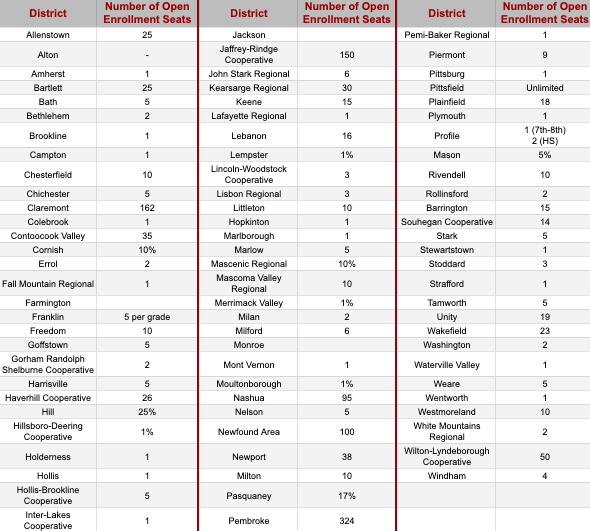
So, what does all of this mean? The current system of open enrollment can create surprise tuition bills for districts, but it allows districts some level of control through the warrant article process. By mandating districts allow at least 10% of students to enroll elsewhere on the resident district’s dime, 751 as amended would remove that level of control for districts and increase the likelihood that districts face surprise, possibly unmanageable tuition bills. This change to current law functionally mandates statewide open enrollment – either a district has a policy allowing at least 10% of the student body to use open enrollment, or a district doesn’t have a policy and any student can use open enrollment, in all cases generating a tuition bill back to the district – without any of the protections or financial supports districts and advocates have been clamoring for.
Republicans in the Committee of Conference today made the point that the decision is not open enrollment or no open enrollment. The decision is between a new version of open enrollment or the current version under 194-D. And it is true that we need a new version of open enrollment – there are many flaws with current statute. But instead of taking the time to study open enrollment and get the new version right, the Committee has instead given us an even worse approach to the current version.