
Open Enrollment, Again
May 21st, 2026

Bill Watch:
On Monday, a Committee of Conference discussed yet another version of the open enrollment bill, this time using the vehicle of HB 751. The new version of the bill largely mirrors the version of SB 101 that failed to advance on the House floor, but it adds an enrollment cap, along with some other more minor changes.
Understanding the enrollment cap
The proposed amendment would limit open enrollment to 500 students statewide in year one (students already using open enrollment would be exempt from the cap). Districts would still determine their capacity – and could still set open enrollment capacity at 0 – but in the event that total open enrollment capacity across the state is greater than 500, the Department of Education will determine which seats to authorize, with a goal of ensuring a fair geographic distribution of available seats.
This approach to a cap limits the initial financial risk to the state, and should ensure that no one district is experiencing a disproportionate benefit from open enrollment. But it does not necessarily protect districts from experiencing a disproportionate drop in enrollment, unless departures are limited naturally by the number of available seats within reasonable driving distance.
Similar to the voucher enrollment cap, the open enrollment cap will increase by 25% in each year that the number of enrolled students exceeds 90% of the current year’s cap. So, if 450 students use open enrollment in 2027-28, the cap increases to 625 for 2028-29. If the cap does not increase for two consecutive years – that is, if enrollment doesn’t reach that 90% threshold – the cap is eliminated, as is the role of NHED in ensuring a fair geographic distribution of seats.
The mechanics are a little different than in the voucher program, because the increase is based on the number of students who use the program, but the cap is applied to the number of available seats. It’s possible to imagine a scenario where enrollment does not reach that 90% threshold simply because the approved seats are not in districts families are looking to transfer into. Once the cap is removed, and any district can offer any seat it wants, demand may shoot up.
Potential financial impact
NHED offered a fiscal analysis based on the new version of the bill, estimating a cost to the state of $2.65 million in year 1 and $3.375 million in year 2. As we have written before, it’s impossible to project a precise cost without knowing where students are coming from. The fiscal note runs through some of the scenarios: if a student leaves a private school for an open enrollment school, that is a new cost of nearly $10,000 to the state. But if a student leaves a school that receives significant targeted aid, there are some cases where that could yield a net savings to the state (though, on average, it will still generate a $4,000 new cost to the state).
Given the complexities of the calculation, the Department uses roughly the amount of the open enrollment bonus – that is, the $5,300 the state would send a school for an open enrollment student, on top of adequacy and differentiated aid – to estimate total cost. Using the Department’s numbers, and assuming a 2% annual increase in adequacy and the open enrollment bonus as currently in statute, we estimate the cost of the program over time, assuming enrollment meets the cap each year.
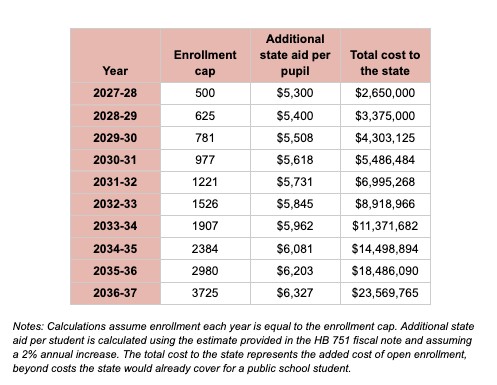
The enrollment cap limits the initial fiscal impact and significantly slows the growth of the program, but open enrollment still has the potential to be a significant additional cost to the state, while benefiting a relatively limited number of students. If the goal is truly to improve educational outcomes regardless of zip code, there are likely more effective uses for $5 or $10 or $20 million (for instance, targeting that extra funding to lower property wealth towns). If the goal is to simply offer yet another educational pathway, legislators will need to weigh whether committing to that eventual cost is worth it.
Multiple pathways to the same place
The proposed language of HB 751 allows districts to set the capacity of programs within their schools, and explicitly instructs districts to publish “the number of available allocated open enrollment seats for each school, grade level, career and technical education program, and other academic programs with enrollment limitations.”
This approach to capacity raises several questions. Can students use open enrollment to access only a specific program, and take the remainder of their classes at their district school (or even a private school)? Do students apply for specific programs when they use open enrollment? What happens if in-district demand for a program exceeds expectations? Will NHED be authorizing seats in certain programs, as part of its role administering the cap?
But the inclusion of career and technical education (CTE) raises the biggest questions, particularly because a version of open enrollment already exists for CTE. Most schools don’t offer CTE at their location, but all students have access to CTE through their local public school’s Regional Career and Technical Education Agreement (RCTEA). Local high schools have area agreements with a regional CTE center, allowing students to enroll in CTE programs outside their district. Legislation passed in 2025 allows students attending CTE outside their resident district to also take other courses in district where they take CTE on either a full- or part-time basis. Under RSA 188-E:1-a, the resident district pays 80% of its cost per pupil (prorated for part-time enrollment) to the receiving district. (If that number sounds familiar, it’s because it’s the metric currently used for open enrollment, and the one pitched in initial versions of SB 101.)
Including CTE in HB 751 effectively creates two pathways to the same place. Let’s say a student at Merrimack Valley wanted to enroll in the Health Sciences program at the Concord Regional Technical Center, and wanted to take the rest of their courseload at Concord. Under existing law, that student would use the CTE access program, and Merrimack Valley would pay Concord 80% of Merrimack Valley’s cost per pupil. But under HB 751, that student could enroll in Concord as an open enrollment student, which would cost Merrimack Valley nothing but would cost the state roughly $5,300. Concord nets more money in the first scenario, but the second is better for Merrimack Valley. At best, this is confusing to families and to districts, and at worst, it will lead districts to push students to the pathway that is most lucrative for them.
Follow us on Facebook, Instagram, and LinkedIn, and receive the New Hampshire Education Briefing.