
What Crossed Over: Teaching & Learning
April 15th, 2026
March 26 marked the halfway point of the 2026 legislative session. At this point, bills have either “crossed over” – gone from one chamber to another – or died. In this series, we’ll take a high-level look at the issues we are following, which bills made it to Crossover, which didn’t, and what we’re watching as the session marches on.
Bills related to the teaching and learning experience spanned a variety of topics, from bullying to recess, book bans, curriculum changes, and teacher requirements. Here, we summarize some of the important bills and themes.
What made it to Crossover
Monitoring what teachers teach and what students read
Perhaps the most high profile bill was HB 1792 (Rep. Belcher), nicknamed the “CHARLIE Act,” which would allow parents to sue teachers if they feel the teacher has been promoting “leftist ideology.” There are a lot of questions about the bill – it makes it hard to say exactly what the bill would actually do, because so much of the language is vague – and in a Senate committee hearing the Attorney General’s office indicated they did not think the bill would stand up to legal scrutiny (read: there will be lawsuits). The Senate committee has yet to make a recommendation on the bill.
Many of the bills coming from the Senate to the House similarly attempt to dictate what teachers can do and similarly are vague enough that the teachers unions and others worry about implementation. One such bill, SB 430 (Sen. Lang), would require teachers to respond “completely and honestly” in writing within 10 days to any inquiry from a parent or guardian. Opponents of the bill worry about the vague standard (who decides whether an answer is complete or honest?), the potential added workload, and the risk that teachers might be forced to reveal sensitive information, undermining a student’s trust or, in the worst cases, putting them at risk. SB 430 was heard by the House Education Policy and Administration committee on April 6.
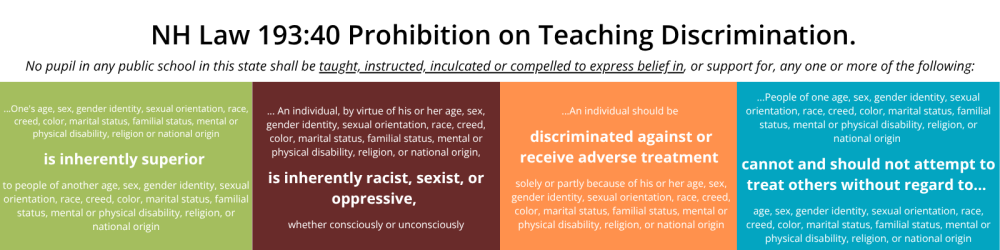
Another bill from Sen. Lang aims to clean up some vague language. SB 431 would amend the “divisive concepts” law (RSA 193:40) by clarifying that it is only a violation if teachers “intentionally or knowingly” teach one of the banned concepts, which deal with race, sexual orientation, and other identity topics. The law has been struck down by the courts because of its vagueness. While SB 431 only deals with the "intentionally and knowingly” change, many advocates have approached the hearings as a broader referendum on the law itself, highlighting the chilling effect it will have on teachers and the ways it will limit student learning.
SB 434 (Sen. Lang) is another bill that aims to restrict the content students have access to in school. This bill requires school districts to have a policy to address complaints about “inappropriate” material. Book ban bills in previous sessions have not survived the governor’s desk, but this bill had a hearing in the House Education Policy & Administration committee on April 6.
Recess
At the start of the session, RHNH was following two bills aimed at expanding access to recess. The Senate recess bill, SB 578 (Sen. Sullivan), made it to the House, albeit in a slightly different form. The amended bill allows elementary and middle schools to count recess as instructional time, in response to concerns that schools might have to extend the school day to accommodate the required amount of instructional time and potential new recess requirements.
Bullying and discipline
The Senate advanced SB 575 (Sen. Fenton), which would create a study committee on school bullying. The Senate also advanced an amended version of SB 507 (Sen. Murphy), which now creates a committee to study violence against staff members. Originally, this bill would have limited districts’ financial obligation to students expelled for assaulting staff members. The House advanced HB 131 (Rep. Ladd), though it has already been amended by the Senate Education committee. The bill changes the standard for negligence related to bullying, in a way many argue is too vague, and adds requirements for school district bullying policies.
What didn’t make it to Crossover
With the exception of the recess bill, any bills that would have added curricular requirements failed to advance, largely because of concerns about the increasing number of requirements and whether schools can reasonably meet these requirements within a standard school day. Such bills included HB 1183 (Rep. Ladd), which would have increased the high school math requirement, and HB 1307 (Rep. Luneau), which would have created a commission to consider a civics curriculum, and HB 1524 (Rep. Read), which would have added a logic and critical thinking course to the high school curriculum. House lawmakers also failed to advance bills requiring gun safety and hunting be integrated into school curricula.
Dig Deeper
Explore tracked bills related to teachers: