
HB 1563: Relative to Special Education Aid
April 10th, 2026

What This Means:
On Monday, the Senate Education Finance Committee will hear testimony on HB1563 (Rep. Ladd), which makes changes to the funding formula for special education. Special education costs have become a hot topic as the number of students with Individualized Education Programs rises and local taxpayers feel increasingly squeezed.
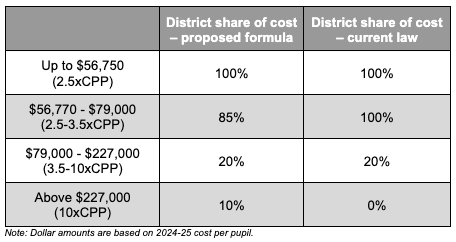
Currently, districts are responsible for all costs up to 3.5 times the statewide average cost per pupil (CPP), which was roughly $22,700 in 2024-25. That means that for a student whose IEP costs $79,000 or less, the district pays everything. Beyond that, the district pays 20% of any additional costs, up to 10 times CPP, or $227,000. The state, in theory, reimburses the district for remaining costs, though there are provisions in the law that allow the state to prorate its share of special education costs.
HB 1563 has been through several iterations, but the version that passed the House changes the formula by lowering the threshold for state reimbursement but increasing district liability for the most expensive students. Under the bill, districts pay all costs up to 2.5 times CPP ($56,750), 85% of costs between 2.5 times CPP and 3.5 times CPP, 20 percent of costs between 3.5 times CPP and 10 times CPP, and 10% of costs above CPP. This formula is outlined in the table below:
For context, the average cost to educate a student with an IEP in 2023-24 was roughly $50,000, according to the NH School Funding Fairness Project. The maximum cost submitted for reimbursement in 2024-25 was $591,000, according to the bill’s fiscal note.
Whether the new formula results in a net savings for school districts will depend on how many students in the district fall between the 2.5 CPP and 3.5 CPP threshold and how many receive services costing more than 10 CPP. In a House Finance Committee hearing, the Department of Education offered a “back-of-the-envelope” estimate of $22 million in additional state spending, which would be a corresponding $22 million savings at the local level. These estimates are rough, because the department does not currently have data on students with IEPs whose services cost less than 3.5 CPP.
The calculator below lets you simulate what these changes could mean for students whose services cost different amounts. You can see that in most cases, the new formula is more generous, but for the highest cost students the formula leaves more of the burden with the district.
To use this chart, enter the cost of providing special education services to each student (up to 19 students) in the yellow cells to the far left. The formula defined in HB 1563 will be applied to each and the amount of district liability will appear in the first column. The second column will display the district libility under current law and the third column will show you the difference. Totals for each column appear at the bottom of the chart.
In addition to the formula changes, however, the bill also adds some process changes. The bill requires school districts to:
-
Demonstrate they have tried to access other reimbursement mechanisms, including Medicaid-to-schools and private insurance.
-
Only submit costs that are “necessary, reasonable, [and] directly benefit the student's education and disability needs as outlined in their IEP.”
-
Provide documentation of the specific costs for each student.
-
Submit a certified report for each student that includes a student identifier and lists all the services they’ve received, along with associated costs.
The bill also implements a monitoring process. The Department of Education would be required to review 20% of districts each year to ensure compliance and accurate reporting.
The number of students with IEPs has been trending upward across the country, and NH’s share of special education students is higher than the national average. The reporting and monitoring provisions in the bill are a response to the idea held by some lawmakers that districts are overidentifying students in order to access more state money. (There is no evidence this is the case.) But special education administrators and others worry about the increased complexity and administrative burden, along with the privacy risks of reporting specific services associated with a student identifier. Changes to the Medicaid-to-Schools program will make it harder to associate exact costs with specific students, and requiring detailed reporting for a greater number of students – and requiring that reporting to be reviewed regularly – will increase burden on districts and the Department. In the House Finance committee hearing, the Department indicated it might need six new staff members to implement the proposed processes.
These processes might be particularly tricky for some districts if the open enrollment law passes as currently proposed. SB 101 states that for a student with an IEP who uses open enrollment, the sending district is responsible for all costs and for service provision. But if a district has students attending several different schools across different districts, not only will it likely increase the cost of service provision, it will also increase the challenge of documenting the exact costs and services provided for each student. At a time when districts are already struggling to fill special education staff positions, such complexity could leave staff stretched then, could demand more resources, and could increase the chances a student falls through the cracks.
Special education has become a hot topic in Concord and at local school district meetings. Fixing the formula and lowering the burden on local taxpayers is critical. But HB 1563, in its current form, risks doing the opposite, particularly in small districts where the added administrative costs might outweigh any savings. Careful consideration of the impact on different districts, an understanding of current special education billing processes, and a review of interactions with other pending legislation could help minimize these challenges.