
What this Means: School Funding on the House Floor
March 9th, 2026
Thursday, the House passed HB 1815 (Rep. Lynn), one of 60 bills we’re tracking related to school funding.
HB 1815 is essentially an attempt to undermine the court’s ruling that New Hampshire’s contribution to education funding is unconstitutionally low. The bill does not increase school funding nor does it lower the burden on local property tax payers. In fact, it opens the door for the state to decrease its share of school funding and place more burden on cities and towns. The bill also says that education funding is a matter for the executive and legislative branches only, potentially closing the door for future lawsuits. At the same time, the state is seeking to have two crucial school funding rulings overturned.
Taken together, it is clear that members of the legislative and executive branches are seeking to ensure that the state can remain near last in the nation in contribution to k-12 education.
In 2020-21, the latest year for which nationwide data is available, New Hampshire relied more heavily on local property taxes for education funding than any other state. That year, 62% of New Hampshire’s education funding came from local sources, compared with a national average of 43%. The 30% of funding that came from the state was higher only than Missouri (29.8%), and far from the national average of 45.8% state funding.
But why does state funding matter?
At the local level, funding for municipal services like schools, roads, and public safety is constrained by residents’ ability to pay. If every town had roughly the same wealth, this wouldn’t be a problem. But in New Hampshire, as in most places, this is not the case. In towns where property is more expensive, people with greater means tend to move in. That makes it easier for these towns to raise the money they need for their schools without straining residents’ budgets.
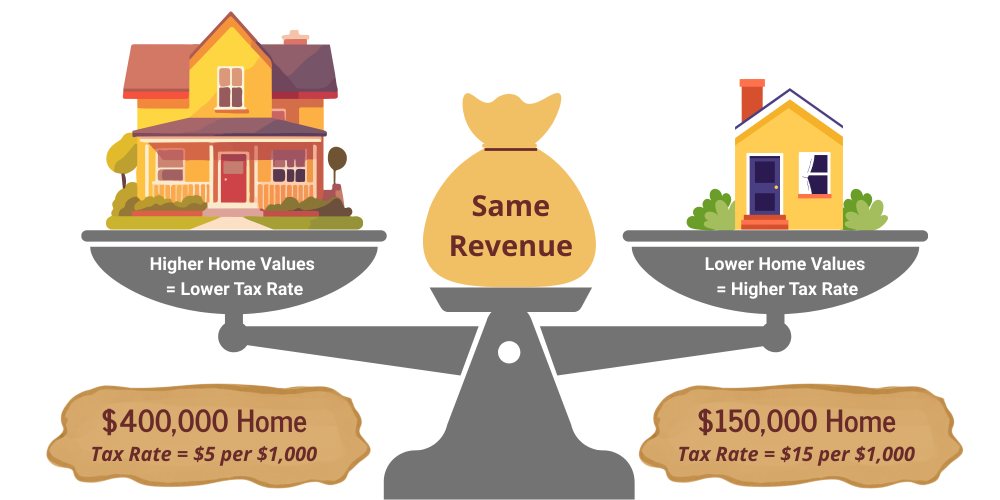
Mechanically, it is easier, too. When home values are higher, a lower property tax rate will generate the same amount of money as a higher rate on a lower value home. The result is the situation we are living in today: the towns with the lowest property values tend to pay the highest property taxes. This discourages investment – what business wants to move to a town with higher property taxes? – which keeps property values low and taxes high. Eventually, in this cycle, even residents who love their public schools will have to vote against a budget increase, and schools will be forced to cut programs or close entirely, further lowering property values.
This particular cycle is not unique to New Hampshire, but it is why every other state provides more centralized resources for education. The Education Commission of the States cites fairness as a core component of sound school funding policy, and specifically suggests adjusting for differences in local wealth. State-level funding allows state governments to equalize resources, redirecting some revenue from higher wealth communities to lower wealth communities. States raise these resources in a variety of ways, including income taxes, sales taxes, or business taxes.
A 2020 report commissioned by the NH Legislative Commission to Study School Funding and conducted by experts at the American Institute for Research said that: “New Hampshire’s current system of funding is not working for large segments of New Hampshire’s students and taxpayers. Specifically, communities with higher poverty rates and lower property wealth are doubly penalized under New Hampshire’s current system. Students in these communities, on average, receive fewer resources in the form of funding than students in wealthier communities. Taxpayers in these communities do their best to provide for their children, often levying higher local education property taxes than residents of wealthier communities.”
Indeed, NH data show a negative correlation between property values and local tax rates – that is, the lower the property values, the higher the tax rates. A 2024 report titled The Adequacy and Fairness of State School Finance Systems ranked New Hampshire high relative to other states in total funding provided, but found that New Hampshire has the third most unequal opportunity. Put simply: our rich districts are doing great, but our poorer districts are lagging further and further behind.
Even Republican members of the legislature have expressed concern, with Rep. Spilsbury introducing a bill this year that would have returned the Statewide Education Property Tax (SWEPT) to a true statewide tax, collected by the state and redistributed based on need. Such a system would help equalize resources and opportunities across town lines. The bill was referred to interim study.
Why should we care about fairness?
In his testimony on HB 1800, Rep. Spilsbury described the “doom loop” faced by his town, Charlestown, and others like it. These towns, where taxes are high and outcomes relatively low, can’t attract developers or new money. There is no one moving to town, which means the tax base doesn’t expand, increasing pressure on those who live there. It means residents pay more to get less. And it means no investment in amenities that might better the lives of those who live there.
But those effects aren’t bound by town borders. If Charlestown were thriving, it would benefit Claremont, Newport, Goshen, and the towns around it. More investment means better public services – including schools – which improves quality of life for residents and can attract visitors and new businesses. A business setting up shop in Charlestown would create opportunities for residents of the surrounding towns, and likely bring in new residents, with their property tax dollars.
And ultimately, the students from Charlestown – and Berlin, and Claremont, and Franklin, and Manchester – are going to go on to live and work in other parts of the state. A resident of a property-rich town may one day be relying on a graduate from a property-poor town to be their doctor or teach their grandchildren. The benefits of education extend beyond town lines.
What’s next for school funding
The Senate Education Finance committee will hold a hearing on HB 1815 (and its twin bill, SB 659) this Friday. Several other funding bills are still working their way through the legislative process, including HB 1121, which attempts to define the components of an adequate education, and HB 1563, which would change the special education aid formula. Most bills on school funding failed to make it out of committee; even a bill to study methods for increasing education funding was referred to interim study.