
School Enrollment Reflects NH's Changing Demographics
December 1st, 2025
Much has been written already about the latest enrollment numbers from the NH Department of Education, which show a continued downward trend in public school enrollment in the Granite State. A deeper dive into the data reveals that the decline is not just a public school problem, but a population problem.
NHED has not yet released reports on the number of students living in each town this year (ADM-R), but we do have enrollment reports from public schools, nonpublic schools, and home education. The nonpublic and home education enrollments likely account for some students receiving vouchers through the Education Freedom Account (EFA) program, though that data has not been released yet, either. Still, we have enough to assess trends.
First grade enrollment is down across the board
And the trends show an overall decrease in the number of first graders across all education types since 2022. This aligns with research showing a decline in birth rates in the Granite State.
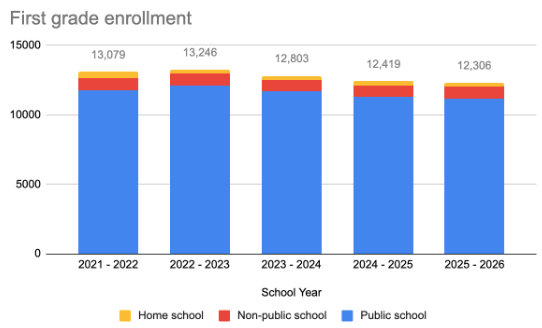
Careful observers will note the number of first graders entering non-public schools grew slightly this year – up 38 students over last year. This doesn’t account for the decline in public school or home school students, and it doesn’t mark a meaningful deviation in the share of families opting to start their children in nonpublic schools.
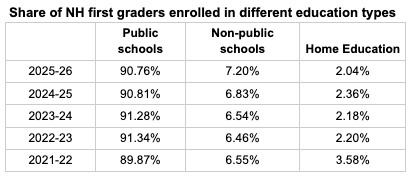
Enrollment patterns remain consistent
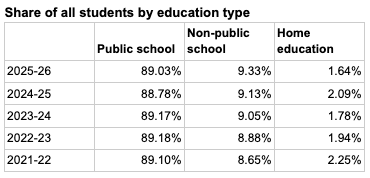
In fact, despite the expansion of the EFA program, there is no evidence of a meaningful change in enrollment patterns. Across all grades, the share of students opting for public school is up very slightly, as is the share of students opting for nonpublic school. Home education enrollments are down marginally (both overall and as a share of total students), though this may be affected by the way the data is collected.
Despite the expansion of the EFA program, there is no evidence of a meaningful change in enrollment patterns.
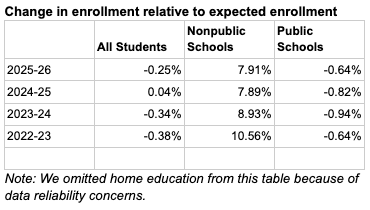
RHNH also looked for trends in transfer or attrition rates – for example, students leaving public school to attend private school or vice versa, or leaving the system completely due to early graduation or moving out of state. Because the state does not collect student-level data for nonpublic schools, and the EFA data noting the number of public school switchers has not been released, we can’t be sure exactly where students leaving one education type are going. But we assumed that most students in grades 1-11 could be expected to return to the same type of education the next year. Comparing one year’s grade 1-11 enrollment to the next year’s grade 2-12 enrollment allows us to see how enrollment is different from what we might expect.
The results are unremarkable.
The results are unremarkable. Across all education types, 371 fewer students enrolled this year than we would have expected. This is likely a combination of families that moved out of state, students finishing high school early or not finishing at all, and those data uncertainties mentioned earlier. Importantly, too, these numbers don’t look markedly different than in previous years. Nonpublic schools routinely show an increase in enrollment over expected – likely a function of school availability and families making different decisions for middle or high school than for elementary school.
Putting it all together, these trends are not unexpected
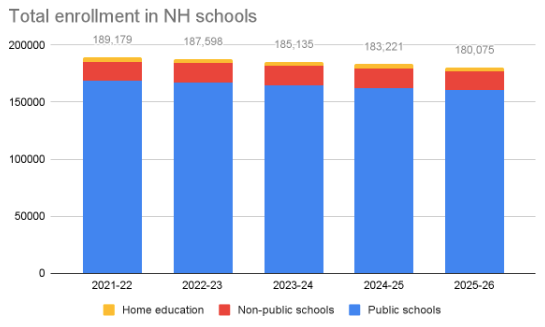
So, what does all of this mean? There's nothing in the data that indicates NH public school students are fleeing for other education types. Rather, it seems that there is the usual attrition (families who move, for instance), combined with a small but steady decrease in the size of the entering cohort. The result: a notable decrease in the number of students being educated in any NH school.
There's nothing in the data that indicates NH public school students are fleeing for other education types.
Declining enrollment has implications for policy conversations
The implications of falling enrollment are important. The public school funding conversation in NH routinely centers on cost per pupil, a crude metric that takes a school’s total expenses and divides it by the number of students. As the number of students falls, the cost per pupil increases – not because schools are spending more, but because the denominator of the cost per pupil equation has decreased. This can put pressure on schools to cut costs, even though the enrollment decreases are not large enough to allow for meaningful cost-saving measures. For instance, enrolling two or three fewer first graders than last year is unlikely to mean you can cut a teaching position or downsize to a smaller building.
As the number of students falls, the cost per pupil increases – not because schools are spending more, but because the denominator of the cost per pupil equation has decreased.
NH Fiscal Policy Institute research has found that New Hampshire’s population skews older than most other states: we have a larger share of residents over 65 than the national average, and our population of children under 18 declined the fastest of any state from 2010-2020. Reversing these trends is important to ensuring the state has the future workforce it needs to support the economy and an aging population. Attracting families to NH can help ensure the state’s economic future, but without investment in education and affordability, it’s likely the downward enrollment trend will continue.
Some data notes: The “public schools” category includes public charter schools. Data is drawn from the following NHED reports: District Fall Enrollment, State Totals, Home Education Fall Enrollments, NonPublic School Enrollments. Nonpublic schools report the total number of students in attendance, regardless of whether students are attending through the EFA program. Nonpublic schools report counts only, not student-level data. The state treats home education and the EFA program as separate pathways, but reporting does not always follow this protocol. The home education numbers here likely include some EFA students, but may not include all students using EFAs for home education.
Have a question? Contact us. Stay in the know and follow us on Facebook, Instagram, and LinkedIn, and join the New Hampshire Education Network (NHEN), our network of New Hampshire parents, educators, business leaders, and community members to stay up to date on the latest developments in education policy.